
Yes — singing can absolutely be learned by almost anyone at almost any age. The reason is simple: singing is a motor skill, not a gift.
Singing depends on breath control, muscle memory, auditory feedback, and neural pathways that strengthen through practice. In many ways, it works like learning a tennis serve or a dance step.
However, the belief that you either have a voice or you do not remains one of music’s most persistent myths. Too often, it prevents people from discovering what they are actually capable of.
This article explores the science behind singing. It also explains common misconceptions and vocal growth.
The Science Settled This Debate — Most People Just Have Not Heard About It
The question of whether people can learn to sing used to feel philosophical. Now it is neurological, and the answer is clearer than most people expect.
What Brain Research Reveals About Singing Ability
Research from the National Center for Voice and Speech (2025) examined trained singers and non-singers inside an MRI scanner as they sang easy and difficult melodies.
On easy melodies, the two groups performed with almost identical pitch accuracy. The difference only appeared on difficult material, where trained singers significantly outperformed their untrained counterparts.
The researcher’s conclusion confirmed that most people already possess a baseline ability to sing. Instead, practice creates the difference between trained and untrained singers.
The distinction does not come from different vocal equipment. Rather, it comes from a learned set of skills developed through practice.
A structured vocal training program studied in ScienceDirect (2025) confirmed the same principle, finding measurable improvements in pitch accuracy, vocal clarity, tone quality, and singing range across participants of varying starting levels after consistent, structured practice.
Why the Brain Can Learn to Sing
The neurological basis for this is well established. Research published in Frontiers in Human Neuroscience describes singing as a sensorimotor process — the voice is controlled by a sophisticated network spanning the motor cortex, auditory cortex, and the regions responsible for coordinating what the brain hears with what the body produces. That coordination is trainable. It is not fixed at birth.
Brain plasticity allows anyone to learn, improve, and refine their singing skills at virtually any stage of life.
The Real Cause of Most Singing Difficulties
Research shows that poor singing stems from sensorimotor translation deficits and motor coordination issues, not perceptual problems.
In plain terms: the ear can usually hear the note accurately. The problem is in the coordination between what the brain hears and what the voice produces. And coordination is exactly the kind of problem that training fixes.
So Why Do So Many People Believe They Cannot Sing?
If the science is this clear, why does the belief that singing is an innate talent persist so stubbornly? This belief stems from culture, personal experiences, and a lack of proper vocal instruction at the right moment.
How Early Experiences Shape Self-Perception
Think about how most people encounter singing as children. They sing in a school chorus where the goal is blend, not individual development. They sing along to recordings where the original artist’s professional production makes every amateur attempt sound inadequate by comparison.
Offhand feedback from parents or teachers often feels like a permanent verdict on a child’s natural singing capability.
The distinction between those two things is enormous, but in the moment, a ten-year-old cannot make it.
The Impact of Feedback on Young Singers
Too often, children never receive guidance that helps them understand what their voices are doing and why. Instead, they continue singing without learning the specific skills that could help them improve.
Research published in 2025 on cultivating singing skills through vocal modeling and feedback makes this explicit: teaching children to sing is a complex, highly specific pedagogical skill.
However, effective modeling and constructive feedback can change how young students perceive themselves and their willingness to sing.
The inverse is also true. When it is done poorly, or not done at all, the child concludes that the voice is the problem. It almost never is.
People who believe they cannot sing usually just lack proper vocal training, rather than actual biological capability
What “Learning to Sing” Actually Involves
Singing feels like an unteachable gift because few people understand the physical mechanics behind proper vocal production. Understanding the mechanism makes the learnability obvious.
Why Breath Support Comes First
Singing requires the simultaneous coordination of several physical systems. Breath support — the steady, controlled flow of air from the diaphragm that the voice rides rather than fights — is the foundation. Without it, notes collapse, phrases run short, and the throat compensates by tensing, which constricts the sound. Breath support is entirely trainable and is typically the first thing a vocal coach addresses with a beginner, because the improvement it produces is immediate and audible.
How Pitch Matching Improves With Practice
Pitch matching — the ability to hear a note and produce it accurately — is the skill most people assume is genetic. It is not. A 2025 study published in Frontiers in Psychology tracked children’s singing development over six months using the Singing Voice Development Measure. Researchers found significant improvements in singing competency, even among children with little or no previous formal singing experience.
Building Tone, Range, and Vocal Expression
Tone quality, range, resonance, articulation, and emotional expressiveness are all trainable skills that develop progressively with proper instruction.
PMC research on singing lessons and vocal development describes the voice lesson as a complex sensorimotor coordination process where progress depends on the quality of the teacher-student dynamic, the consistency of practice between sessions, and the development of the student’s own ability to hear the difference between what their voice is doing and what it needs to do. All of these are learnable. None of them are innate.
What Changes When the Teaching Is Right
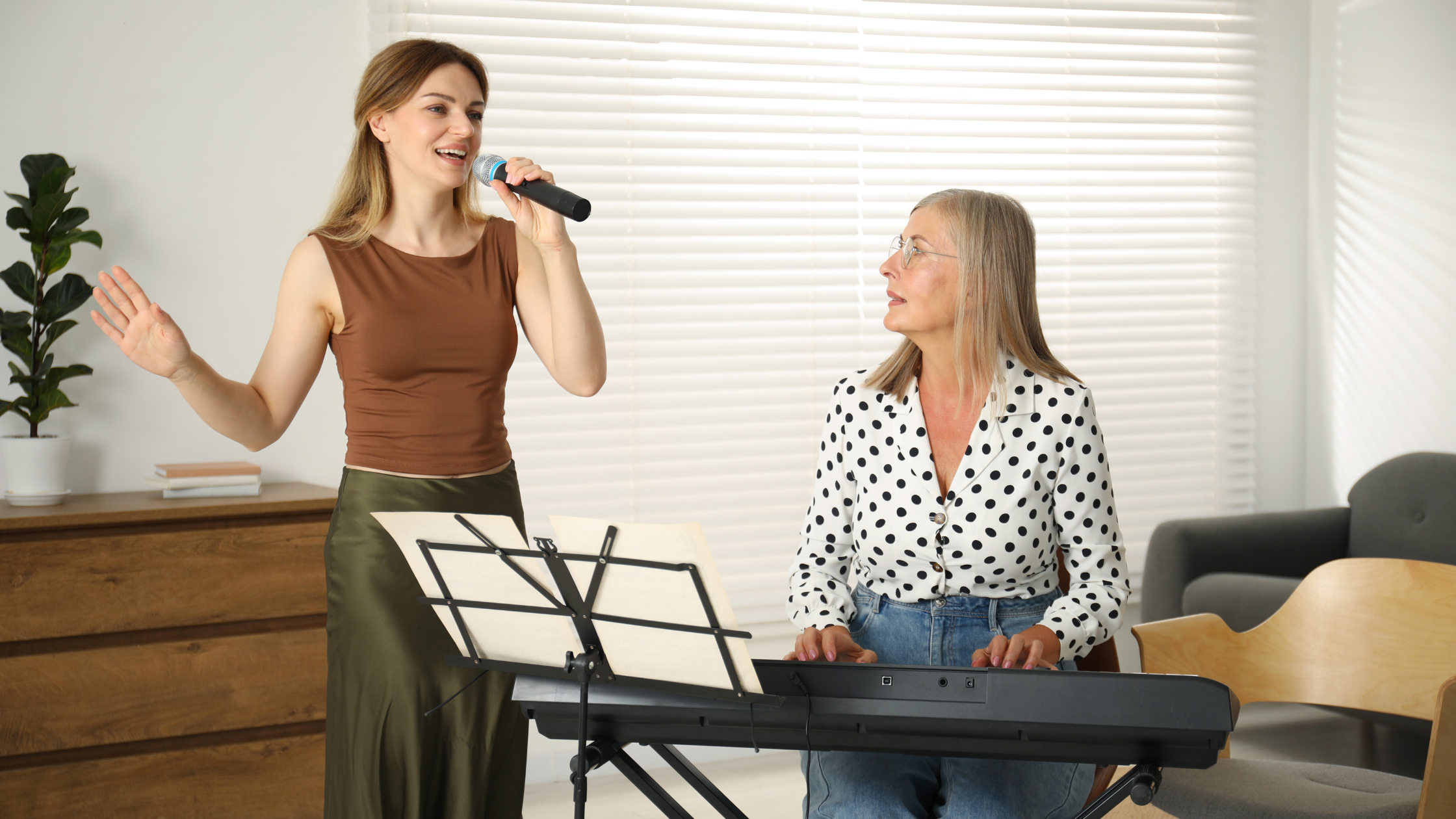
The difference between a singer who progresses quickly and one who plateaus for years is almost never vocal talent. It is the quality of the instruction, the environment it happens in, and whether the feedback the student receives is specific enough to actually change something.
Why Professional Feedback Accelerates Progress
Here is what good vocal instruction does that generic singing practice does not:
- It provides feedback from outside the voice. The single most persistent obstacle in self-directed vocal learning is that the voice sounds different from the inside than it does from the outside. A student can spend months reinforcing a habit that feels right and sounds wrong, with no mechanism to know the difference.
- A qualified instructor hears what the student cannot hear about themselves — and that external perspective compresses years of trial and error into months of targeted correction.
- It addresses the physical causes of vocal problems, not just the symptoms. A student who consistently goes flat on high notes is not simply “bad at high notes.” There is a physical reason — a breath support issue, a laryngeal tension pattern, a registration problem — and a good teacher identifies it and addresses the cause, not just the result.
- It builds the auditory feedback loop. Over time, trained singers develop a more sophisticated internal sense of what their voice is producing — they become better at hearing themselves accurately, adjusting in real time, and reproducing a sound consistently. This is a learned skill, not a born one, and it is what distinguishes a singer who performs reliably under pressure from one whose voice behaves differently every time.
- It creates a track record. Every lesson where a student produces something they could not produce the week before adds to the experiential evidence that growth is possible. That accumulation of small, audible wins is what keeps a developing singer going through the stages of learning that feel stagnant — and it is what transforms the belief “I cannot sing” into something that simply no longer feels true.
The Age Question — Answered Honestly
Two versions of the “can singing be learned” question arrive from opposite ends of the age spectrum. Parents of young children wonder whether it is too early. Adults who have spent decades convinced they cannot sing wonder whether it is too late. Both deserve a straight answer.
Is It Better to Start Singing as a Child?
For children, the earlier the better — not because the voice is more trainable at a young age in any dramatic neurological sense, but because the relationship a child builds with their own voice in the early years shapes everything that follows. A child who grows up in an environment that treats singing as natural, joyful, and learnable does not arrive at formal vocal training needing to dismantle a decade of self-doubt first. They arrive ready.
The 2025 Frontiers in Psychology research on children’s singing development is clear that structured, guided singing practice in young children produces significant improvements in vocal competency — and that the wellbeing benefits of singing persist across the development period as well.
Can Adults Still Learn to Sing?
For adults, the science is equally unambiguous. The brain’s neuroplasticity does not close a door on vocal learning. Research published in Brain Sciences (2025) found that singing and musical activity improve cognitive outcomes and trigger structural brain changes in adults.
The voice takes longer to develop in adulthood than in childhood. The journey requires more patience. But the capacity to learn is genuinely there, and the evidence is consistent enough to say so without qualification.
The Environment That Makes It Real
Knowing that singing can be learned does not automatically tell you where to go to learn it well. And the gap between knowing something is possible and finding the right conditions to actually pursue it is where most people quietly give up — not because they stopped believing in the principle, but because the environment they tried was not built to bring it out of them.
A Real-World Example of Vocal Development
This is the part of the conversation where Girl Pow-R enters — not as a program to be described, but as a living answer to a real question: what does it actually look like when a young person who doubts her voice is put inside the right training environment?
Girl Pow-R was founded in Toronto on International Women’s Day 2017. It is a full pop performance academy — singing, dancing, and acting — that has trained girls from age 2 to 20+ since its inception. What makes it worth paying attention to in a conversation about whether one can learn to sing isn’t the program structure. It is the pattern of outcomes.
How Structured Training Supports Vocal Growth
Girls arrive at the Recreational Pop Star Training Program at every level of starting ability. Some have sung before. Many have not. Some arrive convinced — by a teacher, a parent, or years of their own internal verdict — that their voice is not worth training. What the program does is put those voices inside a framework built on exactly what the research identifies as the conditions for vocal learning: skilled professional instruction, consistent repetition in a structured format, regular performance that builds the auditory feedback loop in real conditions, and a peer community that makes showing up week after week feel worthwhile rather than isolating.
The Role of Expert Vocal Instruction
One of our multi-talented vocal instructors, who is also an award-winning choreographer is Carina. She is a JUNO-nominated artist, graduate of Toronto Metropolitan University’s professional music program, and was Canada’s representative at the 2023 A Cappella championship finals in New York City. She brings a quality of instruction that is genuinely uncommon in youth vocal programs. She does not just teach technique. She hears what is actually happening in a student’s voice, understands why, and addresses the specific physical and psychological barriers that are keeping that voice from developing. That precision is the difference between a student who improves and one who spends a year feeling stuck.
What Consistent Training Can Achieve
The results are not hypothetical. The Girl Pow-R student body has produced a JUNO-nominated album, 2.2 million streams across 240 countries, a single that charted at number 48 on the US Mediabase radio charts, and more than 450 live performances across North America. Every one of those students started somewhere. The ones who produced those results are the ones who stayed in the right environment long enough for the learning to compound.
Training Opportunities for Different Experience Levels
For students who are ready to go further, the Girl Pow-R Pathway raises the standard to include original songwriting, recording, music video performance, Hollywood training intensives, and the opportunity to audition with a Disney Casting Director. And for the youngest voices, the Little Stars program begins introducing music, movement, and vocal play from age 2 — building the foundation before we need to apply any formal technique. Read more about the mission behind the program on the Girl Pow-R About Us page.
The Real Question Was Never Whether Singing Can Be Learned
It always was: what is stopping you from finding out?
What the Evidence Ultimately Shows
The science is clear. The voice is trainable. Pitch accuracy is a motor skill. Breath support is a technique. Tone quality is developed through repetition and feedback. The neural pathways that produce singing are plastic — they respond to practice and reshape themselves around it at virtually any age.
The belief that you either have it or you do not does not reflect reality. Instead, that belief often develops when people never receive proper instruction.
Giving Every Voice the Opportunity to Grow
A qualified instructor, a structured environment, consistent practice, and enough time to let the learning compound — and the answer to “can singing be learned” stops being a question. It becomes something a student feels in her own body every time she hits a note she could not reach the month before.
Every voice has a starting point. The only one that never develops is the one that never gets the chance. Explore Girl Pow-R’s programs and give your daughter’s voice the environment it needs to find out what it is actually capable of.