

Confidence is not a personality trait you are either born with or without — it is a skill built through specific experiences, repeated over time, in the right environment. Research from the 2025 National Research Study on Confidence found that nearly half of all Gen Z workers in the United States struggle with inadequate self-confidence, and among teens, fewer than 60% report receiving enough emotional support to navigate those feelings. The confidence gap is real, it is growing, and it starts earlier than most parents realize. Understanding what actually builds confidence — not what tells children they are great, but what genuinely develops their belief in their own capability — is one of the most important investments a parent can make.
What Confidence Actually Is — and What It Is Not
Most people conflate confidence with the absence of fear. They picture a confident person as someone who walks onto a stage, into a classroom, or into a difficult conversation without a trace of nervousness. That image is not just inaccurate — it is harmful, because it sets a standard no real human being ever meets, and it makes everyone who feels nervous conclude that they simply are not confident enough.
Positive Psychology defines real confidence not as the elimination of anxiety but as the belief in one’s ability to handle a situation — even when uncertain, uncomfortable, or under pressure. It is self-efficacy: the internal conviction that effort produces outcomes, that challenges are worth attempting, and that failure is survivable and instructive rather than defining.
A 2025 systematic review published in Discover Education synthesized research from across the globe on what actually shapes confidence in children and adolescents. The conclusion was consistent across studies: confidence is built through lived experience — specifically through attempting challenges, receiving support through difficulty, and accumulating a personal track record of effort-based outcomes. It is not built by being told you are great.
Research by psychologist Eddie Brummelman found that lavish, unearned praise can actually produce lower self-esteem over time and reduce a child’s willingness to take on difficult tasks. The Greater Good Science Center at Berkeley frames it plainly: what builds confidence is not praise of the self, but the repeated experience of engaging meaningfully with the world and discovering you can handle what it asks of you.
That distinction changes where you look for the answer.
Why the Stage Builds Confidence Faster Than Almost Anything Else
Of all the environments that develop genuine confidence in young people, live stage performance is one of the most potent — and one of the most underused.
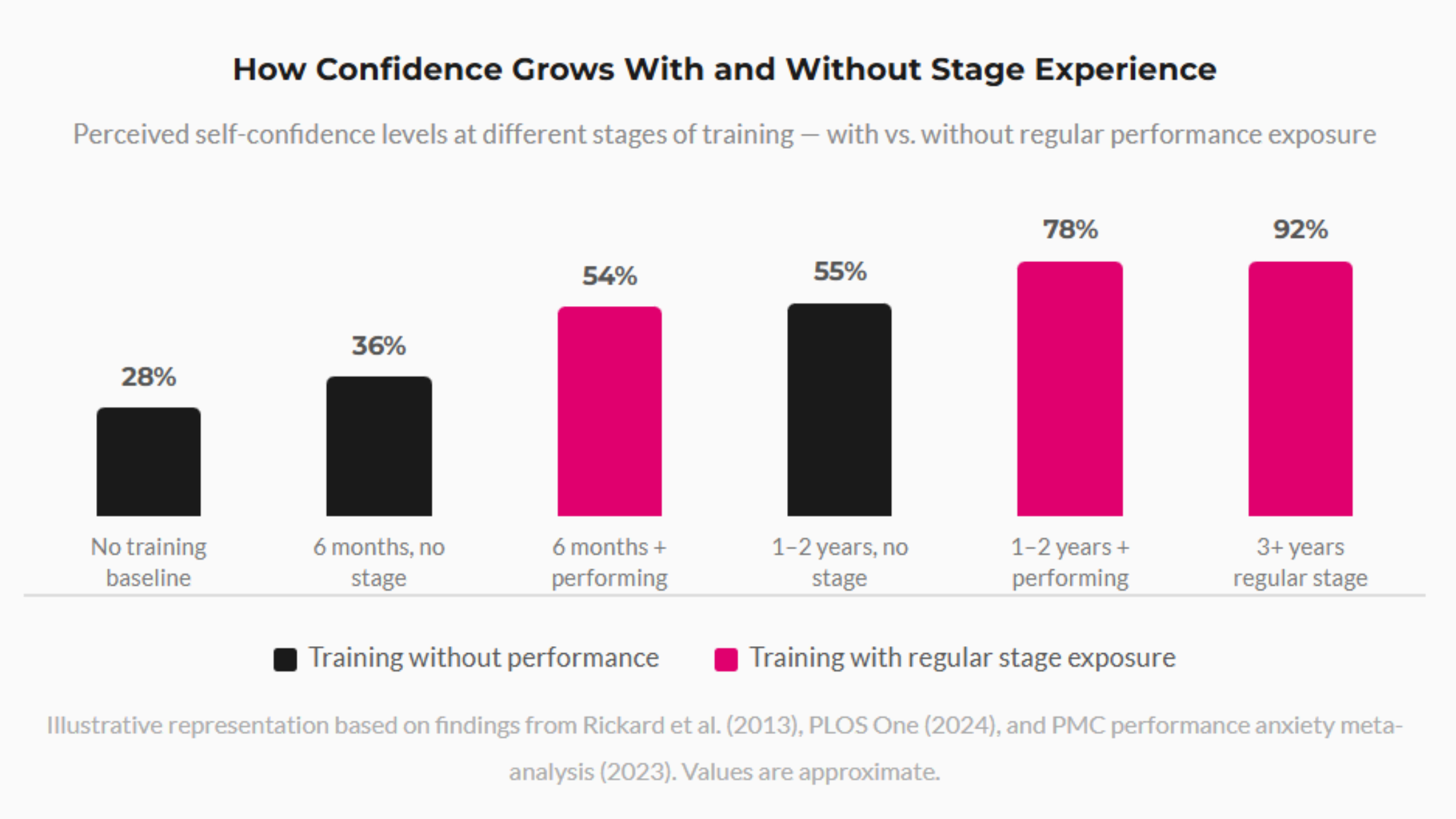
The reason comes down to what performing actually demands. The stage presents a specific, high-stakes scenario where the outcome is public, the pressure is real, and the performer must manage their own internal state while executing a skill in front of an audience. That combination is genuinely hard. And a meta-analysis published in PMC examining psychological interventions across performing arts contexts found that performance training produces large effect sizes on self-confidence — significantly larger than comparable non-performance interventions.
The mechanism is exposure. Anxiety is sustained by avoidance. Every time a child sidesteps a performance because it feels too frightening, the fear compounds. Every time a child performs despite the nerves — survives it, and does it again — the nervous system recalibrates. The stage stops being a threat and starts being recognizable territory. That recalibration does not stay confined to performance. It transfers directly into how a young person carries herself in classrooms, auditions, relationships, and every other room she walks into.
Research in sports psychology adds a layer that most parents are not aware of: reframing the physiological experience of nervousness — the racing heart, the heightened alertness — as excitement rather than fear measurably changes the brain’s response and improves performance quality. Olympic athletes and concert performers train themselves to say “I am excited” instead of “I am scared.” The physical sensation is identical. The interpretation is everything.
Up to 77% of people experience anxiety related to public speaking or performing. Even Adele, Rihanna, and Katy Perry have spoken publicly about severe stage fright. The confidence of a seasoned performer is never the absence of those feelings — it is the accumulated weight of having performed through them, enough times that the pattern becomes familiar and the belief in one’s own capability becomes genuinely durable.
Six Ways to Build Confidence That the Research Actually Supports
Understanding why confidence develops the way it does is one thing. Knowing what to actually do — today, in your daughter’s life — is another. Here are the strategies that consistently show up across the research literature as genuinely effective, not just reassuring.
- Praise effort, never just outcome. The Mental Health Center for Kids cites research showing that children praised specifically for effort — not talent — show greater persistence, enjoy challenges more, and are more willing to attempt difficult things. “You worked really hard on that” builds more durable confidence than “you were perfect.”
- Let them fail without alarm. Confidence does not come from never failing. It comes from learning that failure is not final. Weston Family Psychology identifies mistake tolerance as one of the most critical foundations — when adults respond to a child’s setback with composure rather than panic, children learn that difficulty is a normal part of growth, not a verdict on their worth.
- Build a track record of small, real wins. Confidence is cumulative evidence. The Child Mind Institute recommends giving children age-appropriate responsibilities they can genuinely complete — not because they need to be shielded from failure, but because each completed challenge becomes proof they can call on the next time doubt arrives.
- Perform before feeling ready. Waiting for confidence to arrive before attempting something public is the wrong sequence. Drama Inc. recommends starting with small, supportive audiences and increasing the stakes gradually — because the act of performing is what builds the belief, not the preparation for it.
- Teach them to reframe nervousness. The racing heart before a performance is not a warning signal. It is a readiness signal. Berklee Online describes this reframe as one of the most impactful tools in a performer’s mental toolkit — and it applies far beyond the stage, into every situation where anxiety and capability collide.
- Make imperfection safe at home and in training. Psychology Today’s research on childhood confidence is consistent: children grow fastest in environments where doubt is treated as a navigable, normal experience — not a problem requiring urgent correction. The question to ask a struggling child is not “why are you doubting yourself?” but “what specifically feels hard, and what do you need to get better at it?”
What a Real Confidence-Building Environment Looks Like in Practice
Reading strategies for building confidence is one thing. Finding an environment that puts all of them into practice — consistently, over months and years — is something else entirely. Most programs talk about confidence. Very few are structured in a way that actually produces it at scale.
This is where the story of Girl Pow-R becomes worth telling — but not the way it usually gets told.
The most revealing thing about Girl Pow-R is not its program list or its awards. It is what happens to the students inside it. Girls arrive, often at the Recreational Pop Star Training Program, uncertain about their voice, uncertain about their body on a stage, uncertain whether they belong in a performance space at all. They are not held back from performing until they feel ready. They perform. Early, regularly, and in front of real audiences — in Boston, New York, Philadelphia, Washington D.C., Houston, Dallas, and Kansas City across more than 450 shows since 2017.
That volume of stage experience is not incidental to Girl Pow-R’s outcomes. It is the mechanism. The JUNO nomination in 2020 for Children’s Album of the Year, the 2.2 million streams across 240 countries, the single that charted at number 48 on the US Mediabase radio charts — these are the byproducts of young people who were put on real stages before they felt ready, and who discovered, performance by performance, that they were more capable than they had believed.
Instructor Carina — a JUNO-nominated artist and graduate of Toronto Metropolitan University’s professional music program who represented Canada at the 2023 A Cappella finals in New York City — describes what she watches change in students over months of training not primarily in vocal terms but in identity terms. The student who walked in convinced her voice was not worth hearing, and the student who takes the stage six months later, are genuinely different in how they see themselves and what they believe they are capable of. That shift is what confidence-building actually looks like when the environment is doing its job.
For students ready to go further, the Competitive Pop Star Training Program raises the standard considerably — with original songwriting and recording, Hollywood training intensives, and the opportunity to audition with a Disney Casting Director. But at every level, the organizing principle is the same: growth happens on stages, not just in rehearsal rooms. Learn more about the mission and values driving the program on the Girl Pow-R About Us page.
Confidence is not something a child finds by looking inward. It is something she builds by doing hard things in front of people who matter — and discovering, each time, that she is more capable than she thought.
The Bottom Line
Confidence is built in the doing. In attempting things that feel uncertain. In performing before feeling ready. In failing, and continuing. In building — performance by performance, challenge by challenge — a personal track record of evidence that the nervous system can actually trust the next time doubt arrives.
For young people especially, the stage accelerates that process faster than almost any other environment available. Not because performing is easy. Because the challenge it presents, and the belief it produces when a young person rises to meet it, is exactly the material confidence is made of.
Give your daughter the kind of environment where confidence is not just encouraged — it is built, stage by stage. Explore Girl Pow-R’s programs and find the right starting point for where she is today.